
Powder Coating vs. Liquid Paint in Sheet Metal Fabrication: Which Finish Is Right for Your Project?
When specifying finishes for fabricated metal components, one of the most common questions engineers and procurement teams face is: powder coating or liquid paint? Both finishing systems provide corrosion protection, aesthetic value, and surface durability — but their performance characteristics, cost structures, and application methods differ significantly.
Understanding these differences is critical to selecting the right finish for your sheet metal fabrication project.
Overview of Each Coating System
Powder Coating
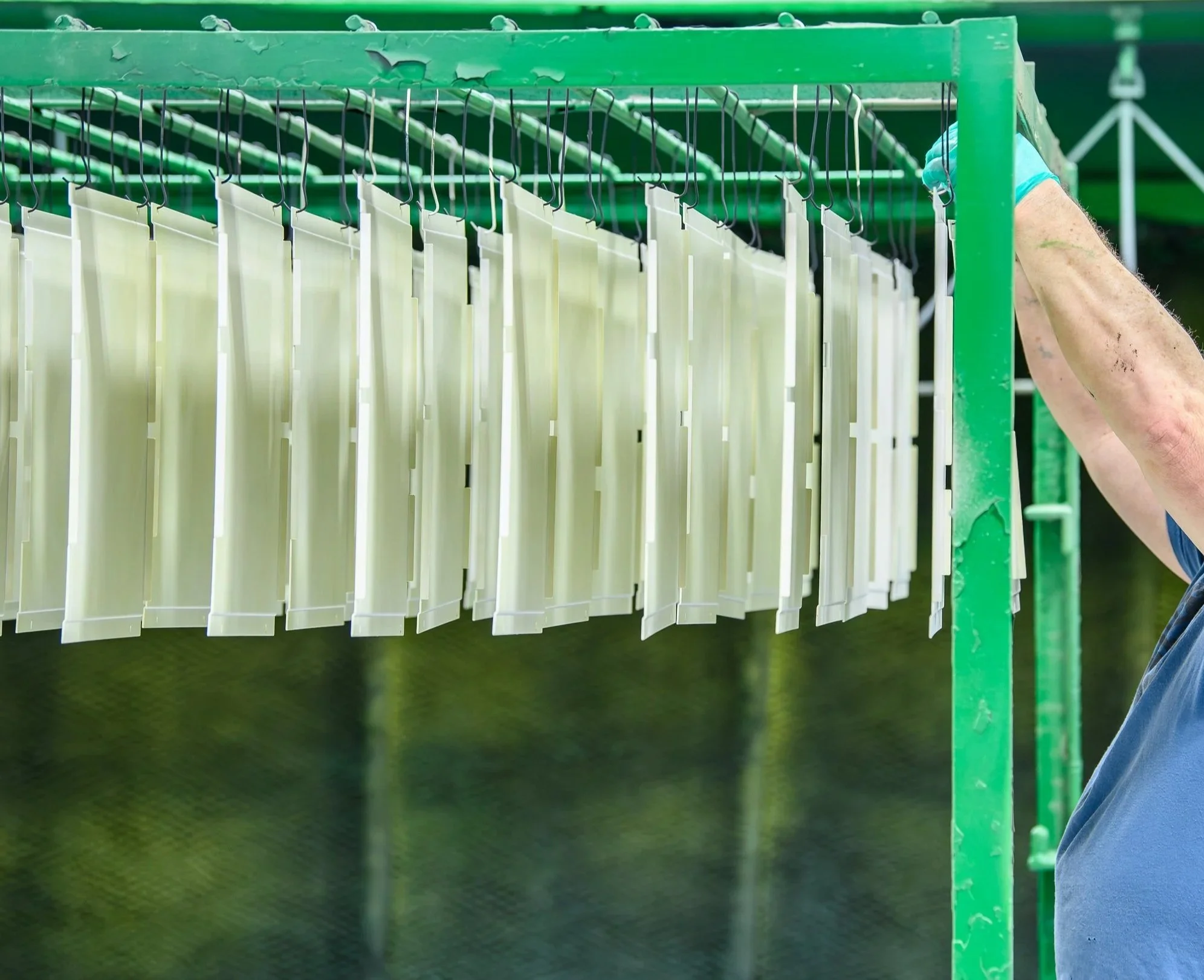
Powder coating is a dry finishing process in which electrostatically charged powder particles are sprayed onto grounded sheet metal parts. The coated components are then cured in an oven, typically between 350–400°F, where the powder melts and chemically crosslinks into a uniform film.
The result is a durable, consistent finish with excellent mechanical properties and corrosion resistance.
Liquid Paint
Liquid paint systems use solvent- or water-based coatings applied via spray guns. These coatings cure through solvent evaporation and chemical reactions, depending on the formulation. Common industrial systems include epoxy primers, polyurethane topcoats, and acrylic enamels.
Liquid paint is highly versatile and can be applied in multiple layers to achieve specific performance characteristics.
Durability & Mechanical Performance
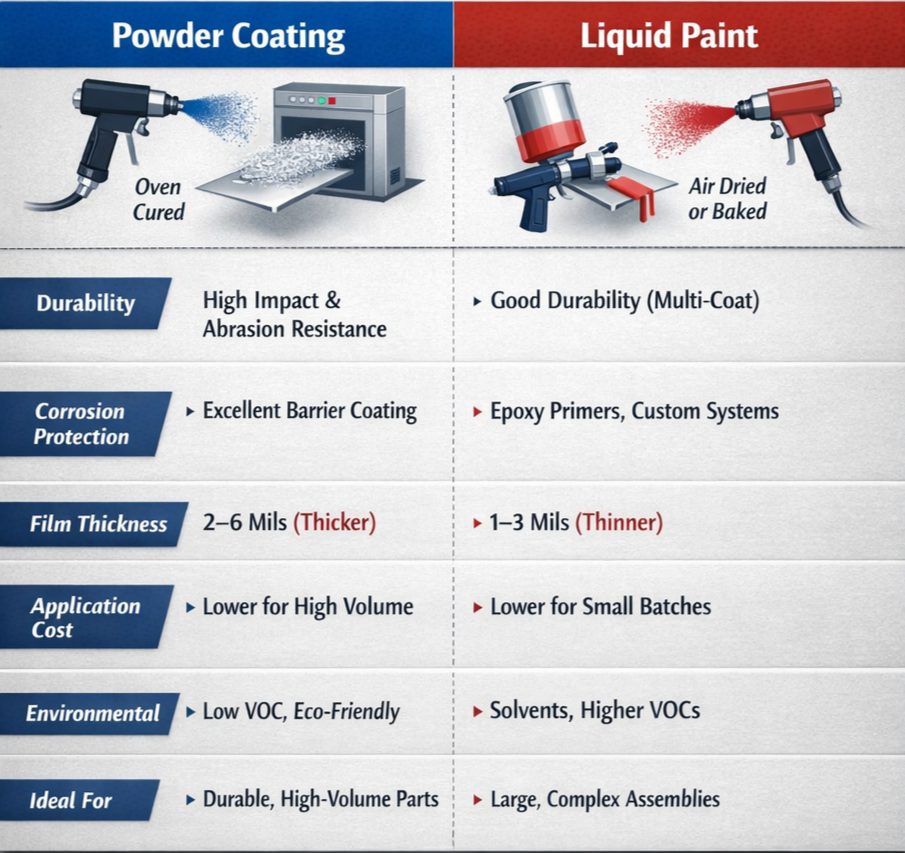
In general, powder coating offers superior mechanical durability compared to standard liquid paint systems.
Powder-coated surfaces tend to provide:
Higher impact resistance
Better abrasion resistance
Improved edge coverage
Greater resistance to chipping and scratching
Because powder coatings are thermoset polymers that fully crosslink during curing, they create a dense and uniform film. Typical dry film thickness ranges from 2–6 mils in a single pass.
Liquid paint systems, while durable, may require multiple coats to achieve comparable protection. However, high-performance liquid systems (such as epoxy/polyurethane combinations) can rival powder coatings in demanding environments.
Best choice for heavy-use parts: Powder coating
Best choice for multi-layer engineered systems: Liquid paint
Corrosion Resistance
Both finishing methods can provide excellent corrosion protection when paired with proper surface preparation.
Surface prep typically includes:
Degreasing
Phosphate conversion coating
Media blasting (if required)
Powder coatings provide consistent film build and strong barrier protection. When applied over pretreated steel or aluminum, they perform well in outdoor and industrial environments.
Liquid paint systems offer more flexibility for corrosion engineering. For example:
Zinc-rich primers for galvanic protection
Epoxy primers for chemical resistance
Polyurethane topcoats for UV stability
If your project requires marine-grade protection or highly specialized chemical resistance, liquid systems may offer more customization options.
Appearance & Finish Quality
Powder coating provides:
Uniform thickness
Smooth or textured finishes
Excellent color consistency
Wide range of gloss levels
It is especially well-suited for architectural panels, enclosures, frames, and consumer-facing components.
Liquid paint excels when:
Ultra-thin coatings are required
Custom color blending is needed
Large or assembled structures cannot fit in curing ovens
Field touch-up may be required
Because powder coating requires oven curing, part size limitations must be considered.
Cost Considerations
Cost comparisons depend on production volume and part geometry.
Powder Coating Cost Factors:
Higher upfront equipment investment
Efficient material utilization (overspray can be reclaimed)
Faster cycle times in high-volume production
Lower VOC compliance costs
Liquid Paint Cost Factors:
Lower equipment cost
Higher material waste (overspray loss)
Potentially longer drying/curing time
VOC compliance considerations
For high-volume production runs, powder coating is often more cost-effective long term.
For low-volume, oversized, or complex assemblies, liquid paint may be more economical.
Environmental & Regulatory Considerations
Powder coating contains little to no volatile organic compounds (VOCs), making it environmentally favorable and easier to maintain regulatory compliance.
Liquid paint systems may contain solvents that require ventilation systems and environmental controls. Water-based formulations reduce VOC impact but may still require additional drying time.
If sustainability and environmental compliance are top priorities, powder coating often has the advantage.
Thickness, Tolerances & Design Considerations
From an engineering perspective, coating thickness affects fit and function.
Powder coating typically applies thicker films, which can:
Impact tight tolerances
Affect threaded holes
Require masking of mating surfaces
Liquid paint systems can be applied more thinly and precisely, which is beneficial for precision components or tight assemblies.
Designers should always specify:
Required dry film thickness (DFT)
Surface preparation standard
Performance testing requirements (salt spray hours, impact resistance, adhesion)
When to Choose Powder Coating
Choose powder coating when:
You need high durability and abrasion resistance
Parts fit within curing oven dimensions
Production volume is moderate to high
Environmental compliance is a priority
Uniform cosmetic finish is required
When to Choose Liquid Paint
Choose liquid paint when:
Parts are oversized or assembled
Custom multi-layer corrosion systems are required
Very thin film build is necessary
Field touch-up or repairability is important
Final Thoughts
Both powder coating and liquid paint are proven finishing options in sheet metal fabrication. The best choice depends on your performance requirements, production volume, environmental exposure, part size, and budget.
Working with an experienced fabrication partner ensures your coating system is specified correctly — balancing durability, aesthetics, cost, and long-term performance.